Evaluating Berke: A Lyrical Display Typeface for Musical Branding
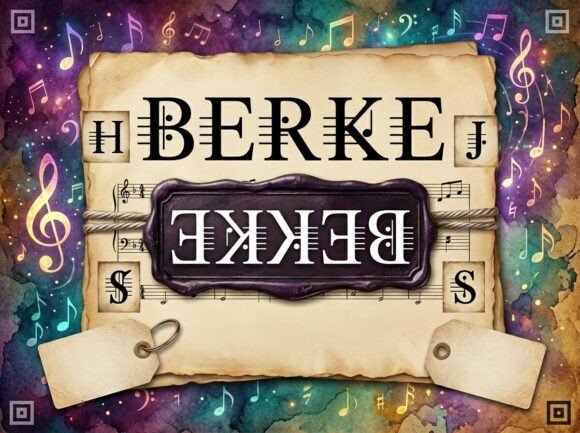
Selecting typography for music-related projects requires balancing aesthetic resonance with functional legibility. Berke is a lyrical display typeface designed specifically to bridge the gap between vintage sheet music aesthetics and modern rhythmic branding. It captures a harmonic and historic soul through classic, high-contrast serif letterforms that are uniquely characterized by hand-drawn musical staff crossbars and note-inspired terminals. For designers, brand managers, and educators evaluating type options, understanding where Berke succeeds—and where it may fall short—is essential for making an informed selection.
Defining the Visual Character of Berke
Berke distinguishes itself from standard serif fonts through specific structural modifications that reference musical notation without becoming purely illustrative. The typeface maintains a medium structural weight, providing enough presence for headlines while retaining the elegance associated with classical music typography. The defining feature lies in the horizontal crossbars and terminals, which mimic the rhythm and flow of a musical staff. These elements are not merely decorative overlays; they are integrated into the glyph construction, suggesting movement and melody within static text.
The high-contrast stroke modulation aligns Berke with the Didone and Modern serif classifications, evoking the era of engraved sheet music and opera playbills. However, the hand-drawn quality of the musical details introduces an artisanal warmth often missing in digital revivals of historical types. This combination creates a visual tension between precision and performance, making it a distinct option for identities that need to communicate both technical proficiency and artistic expression.
Strategic Applications and Ideal Use Cases
Evaluation of Berke should focus on its efficacy in specific contexts rather than general versatility. Its specialized nature makes it particularly strong for niche applications where the audience expects or appreciates musical semiotics.
- Independent Music Academies: Educational institutions often struggle to balance academic rigor with creative inspiration. Berke serves this dual purpose effectively. The serif foundation suggests tradition and established pedagogy, while the lyrical details signal a focus on active performance and artistic development. It works well for academy logos, course catalogs, and recital programs.
- Boutique Opera Houses and Venues: Smaller venues require branding that feels premium yet accessible. Berke provides the necessary sophistication for season announcements and signage without the stiffness of traditional luxury serifs. It helps position boutique organizations as culturally significant but community-oriented.
- Artisanal Instrument Packaging: For luthiers and instrument makers, packaging typography must reflect the craftsmanship of the product. The hand-drawn aspects of Berke mirror the organic curves of wood and string instruments. It is effective on box labels, authenticity certificates, and marketing collateral for high-end audio equipment.
- Social Media Headers and Event Promotion: In digital environments, display typefaces must capture attention quickly. Berke’s unique crossbars create texture at thumbnail sizes, making it suitable for Instagram headers, YouTube banners, and festival posters where immediate thematic recognition is valuable.
Benefits and Functional Advantages
When selected for appropriate projects, Berke offers several tangible benefits over generic alternatives. The primary advantage is immediate semantic communication. Viewers instantly associate the form with music, reducing the cognitive load required to understand the brand's industry. This thematic efficiency is difficult to achieve with standard typography without relying on external iconography.
Additionally, the medium weight ensures better reproduction across various media compared to ultra-thin display faces. While high-contrast serifs can be fragile in print or low-resolution screens, Berke’s structural integrity allows it to maintain readability in secondary headline sizes. The integration of musical elements into the letterform structure also prevents the design from looking like a novelty font; it retains the professional cadence required for serious institutional use.
Tradeoffs and Design Considerations
Despite its strengths, Berke presents specific limitations that must be weighed during the evaluation process. Recognizing these tradeoffs prevents misuse and ensures client expectations align with reality.
Legibility Constraints
The very features that give Berke its character also impose limits on readability. The musical staff crossbars add visual noise that can interfere with word recognition at small sizes or in long-form text. It is strictly a display typeface. Evaluators should test Berke at the smallest intended size early in the design process. If body copy needs to match the header stylistically, a complementary neutral serif or sans-serif will be necessary.
Tonal Specificity
Berke carries a strong historic and acoustic connotation. It may feel out of place for electronic music, hip-hop, or avant-garde genres that prioritize futuristic or brutalist aesthetics. Using Berke in these contexts could create a dissonance between the visual identity and the sonic product. It is best suited for acoustic, classical, jazz, folk, and traditional music sectors.
Licensing and Pairing Complexity
As a specialized display face, Berke requires careful pairing. Selecting a companion typeface that neither competes with nor diminishes Berke’s details can be challenging. Overly ornate pairings will clash, while extremely geometric sans-serifs might feel too cold. Furthermore, users must verify licensing terms for commercial packaging and digital embedding, as display fonts sometimes have different usage tiers than text families.
Comparing Alternatives
Determining whether Berke is the correct choice involves comparing it against other categories of musical typography.
Versus Standard High-Contrast Serifs: Fonts like Bodoni or Didot offer similar elegance and contrast but lack the explicit musical narrative. Choose a standard serif if the project requires maximum neutrality or if the musical connection should be subtle rather than overt. Choose Berke when the musical identity is the primary differentiator.
Versus Script and Hand-Lettering: Custom scripts offer uniqueness but often sacrifice scalability and consistency. Berke provides the warmth of hand-drawn lettering with the uniform spacing and reproducibility of a manufactured typeface. Opt for Berke over custom script when systemization and multi-platform consistency are priorities.
Versus Novelty Music Fonts: Many free or low-cost music fonts replace letters entirely with notes or clefs. These are generally illegible and unprofessional. Berke occupies the middle ground: it references music without sacrificing linguistic function. Avoid pure novelty fonts for any serious branding effort.
Decision-Making Framework
To finalize the decision to adopt Berke, stakeholders should assess three core criteria. First, evaluate the target audience’s expectations. Does the demographic value tradition and craftsmanship, or do they seek innovation and disruption? Berke serves the former. Second, audit the application ecosystem. Will the typeface primarily live in large-format displays and headers, or does it need to perform in 10pt caption text? If the latter is true, Berke is likely unsuitable regardless of aesthetic preference. Third, consider longevity. Trend-driven display faces can date a brand quickly. Berke’s reliance on historic typographic roots suggests greater staying power than purely decorative trends, making it a safer investment for long-term identities.
Ultimately, Berke is a tool for specific storytelling. It excels when the goal is to visualize the intersection of history and harmony. By objectively weighing its lyrical benefits against its functional constraints, designers can determine if it strikes the right chord for their specific project requirements.