Dixon: Evaluating an Eccentric Serif for Niche Branding
In the crowded landscape of display typography, finding a typeface that balances structural integrity with genuine personality is a persistent challenge for designers and brand strategists. Most novelty fonts sacrifice readability for aesthetic gimmicks, while traditional serifs often lack the distinctiveness required for niche marketing. Dixon occupies a specific middle ground in this spectrum. It is a high-contrast display serif that integrates insectoid anatomical references directly into its letterforms without descending into caricature. For professionals managing independent entomology brands, science education initiatives, or whimsical creative projects, understanding the practical utility of Dixon requires looking beyond its novelty to evaluate its performance as a functional design asset.
Anatomical Design and Typographic Structure
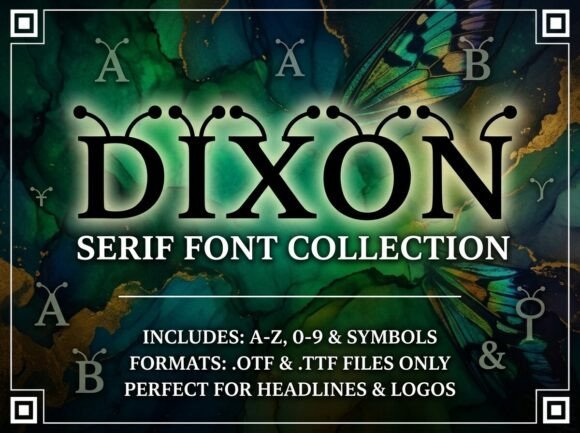
Dixon is defined by the tension between classical serif construction and organic, biological modification. At its core, the font relies on a high-contrast stress model reminiscent of Didone or Modernist serifs. This provides a familiar vertical rhythm and a sense of established authority that anchors the more eccentric elements. The "insectoid soul" of the typeface is not applied as a texture or overlay but is engineered into the skeleton of the glyphs.
The most prominent feature is the treatment of terminals and ascenders. Instead of standard ball terminals or flat serifs, Dixon utilizes spherical nodes and rhythmic, hand-drawn accents that mimic antennae and jointed legs. These modifications are consistent across the character set, creating a cohesive visual language rather than a collection of disjointed illustrations. The bold structural weight ensures that these intricate details remain visible at medium display sizes, preventing the finer biological references from disappearing when the font is scaled down for subheads or pull quotes.
From a technical perspective, the spacing and kerning appear calibrated specifically for display use. The negative space between letters accommodates the protruding organic elements, reducing the risk of visual clutter. This attention to inter-character relationships is what separates a usable professional tool from a decorative afterthought. The result is a typeface that feels alive and kinetic while maintaining the legibility expected of a serif classification.
Practical Applications in Science and Education
The primary value proposition of Dixon lies in its ability to signal subject matter expertise instantly. For independent entomologists, natural history museums, and biodiversity researchers, visual identity often struggles to bridge the gap between academic rigor and public engagement. Standard scientific typography can feel sterile to lay audiences, while cartoonish alternatives undermine credibility. Dixon serves as a typographic translator for these sectors.
In museum exhibit design, for example, headers set in Dixon can guide visitors through taxonomic classifications or ecological narratives with a tone that is both educational and immersive. The font’s inherent curiosity encourages exploration, making it particularly effective for interactive displays or children’s discovery zones where the goal is to demystify complex biological concepts. The playful anatomy of the letterforms acts as a visual hook, drawing attention to signage and interpretive panels without requiring additional graphic embellishment.
For publishers and educators producing field guides, textbooks, or educational supplements, Dixon offers a way to differentiate chapter titles and section breaks from body text. Its distinctive silhouette creates strong navigational landmarks within dense informational layouts. Because the underlying structure remains rooted in traditional serif proportions, it pairs predictably with clean sans-serif or neutral serif body copy, ensuring that the reading experience remains comfortable even when the display typography is highly stylized.
Performance in Commercial and Digital Branding
Beyond institutional use, Dixon has tangible applications in commercial branding for businesses operating within adjacent niches. Sustainable agriculture brands, botanical gardens, eco-tourism operators, and artisanal product lines that reference nature can leverage this typeface to establish a unique market position. In these contexts, Dixon communicates a sense of organic authenticity and meticulous observation that generic earthy or rustic fonts cannot replicate.
In digital environments, specifically social media headers and hero images, Dixon performs well due to its bold weight and high contrast. Social platforms often compress images and reduce text size, which can obliterate delicate details. Dixon’s robust construction survives this degradation better than finer novelty scripts. The spherical terminals and antennae accents remain recognizable even in thumbnail previews, ensuring brand consistency across devices.
However, users must be strategic about hierarchy. Dixon is strictly a display face. Attempting to use it for extended body copy, captions, or UI elements will degrade usability and fatigue readers. Its optimal size range typically sits between 36pt and 72pt for print, or equivalent responsive units for web. Within this range, the biological details are crisp and intentional; outside of it, they either become invisible noise or overwhelming distractions. Successful implementation depends entirely on respecting these boundaries and allowing the font to function solely as a headline or accent element.
Evaluating Versatility and Limitations
While Dixon excels in its intended niche, objective evaluation requires acknowledging its constraints. The typeface is inherently thematic. It carries a strong semantic load associated with insects, biology, and nature. Using Dixon for unrelated industries—such as fintech, legal services, or luxury fashion—would likely create cognitive dissonance and confuse the audience. Unlike neutral grotesques or transitional serifs that adapt to any context, Dixon dictates the tone of the project.
Furthermore, the hand-drawn quality of the antennae accents introduces a level of informality that may not suit all scientific communications. Peer-reviewed journals, regulatory documents, or clinical research presentations typically require stricter typographic neutrality. Dixon is best reserved for public-facing, outreach, or creative aspects of scientific work rather than formal academic dissemination. Professionals should assess whether their specific communication goals align with the font’s whimsical yet structured personality before adoption.
Pairing strategy also demands consideration. Because Dixon possesses such strong character, it requires supportive typography that provides visual rest. High-contrast geometric sans-serifs or muted humanist serifs often work best as companions. Avoid pairing Dixon with other decorative or distressed typefaces, as this competes for attention and muddies the visual message. The goal is to let Dixon serve as the singular focal point of typographic interest within a layout.
Long-Term Value and Workflow Integration
For freelancers and agencies building brand systems for clients in the natural sciences or creative education sectors, Dixon represents a durable asset. Trends in nature-inspired design cycle frequently, moving between minimalism, maximalism, and illustration-heavy aesthetics. Dixon’s foundation in classic serif proportions insulates it from fleeting trend cycles. The biological references are subtle enough to avoid feeling dated when design fashions shift, provided the overall brand identity remains grounded in substance rather than style alone.
From a production standpoint, users should verify licensing terms for intended applications, particularly for commercial merchandise or large-scale environmental graphics. Ensuring proper licensing protects both the designer and the client from future legal complications. Additionally, testing Dixon across various rendering engines is advisable before finalizing web implementations, as high-contrast serifs with fine details can render inconsistently on low-resolution screens. Providing adequate fallback stacks and adjusting CSS font-smoothing properties can mitigate potential display issues.
Ultimately, Dixon succeeds because it solves a specific problem: how to make specialized, potentially intimidating subjects feel accessible and engaging without sacrificing professional polish. It is not a universal solution, nor does it aspire to be. For the right project, however, it eliminates the need for custom lettering or complex illustration work to achieve a similar effect. By integrating form and meaning at the glyph level, Dixon offers efficiency and distinctiveness that justify its place in a curated typographic toolkit. Professionals evaluating this typeface should focus less on its novelty and more on its capacity to clarify communication for audiences who might otherwise overlook the fascinating worlds it represents.