Armin: A Practical Guide to Using Textile-Inspired Typography
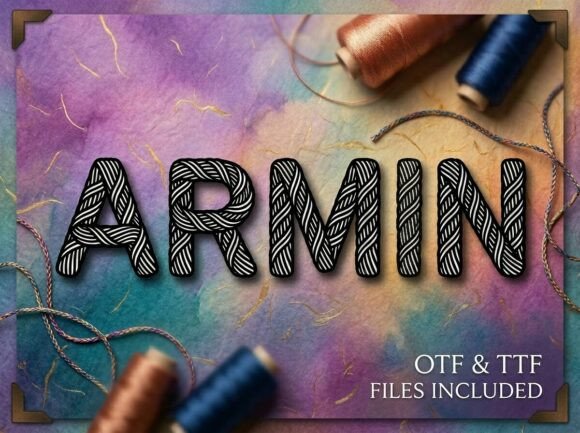
Choosing a typeface for a handcrafted brand often involves a difficult trade-off between legibility and personality. You want the warmth of handmade goods, but standard script fonts can feel cliché, while clean sans-serifs often lack the necessary tactile soul. Armin resolves this tension by functioning as a display typeface that literally embodies the texture of the craft. It is not merely a font that looks handwritten; it is a structural design where bold, rounded letterforms are filled with intricate, rhythmic patterns of twisted rope and yarn.
This specific construction makes Armin a powerful tool for independent knitwear identities, boutique tailors, and artisanal home decor labels. However, its unique internal texture also introduces usability challenges that standard fonts do not have. Many designers and business owners select Armin for its aesthetic appeal but struggle during implementation because they treat it like a conventional typeface. To get the most value from this investment, you must understand its technical limitations and best-use scenarios before applying it to your branding or social media assets.
The Legibility Trap at Small Sizes
The most frequent mistake made with textured display fonts like Armin is attempting to use them below their intended size threshold. Because the letterforms are defined by internal negative space and detailed line work, reducing the font size causes these details to collapse. On screen, this results in a muddy, pixelated appearance where the yarn pattern becomes visual noise rather than a deliberate design element. In print, fine lines may fail to hold ink or appear broken, making the text look damaged rather than rustic.
Practical Correction: Reserve Armin strictly for large-format applications. This includes logo lockups, website hero headers, packaging front-of-house, and high-impact social media graphics. For body copy, subheads, or any text smaller than 24pt (depending on the output medium), pair Armin with a clean, neutral sans-serif or a simple serif. Do not try to force Armin into functional roles like navigation menus or product descriptions. Let it serve as the visual anchor, not the workhorse.
Misjudging Color Contrast and Backgrounds
Armin’s internal texture relies heavily on contrast to be perceived correctly. A common error is placing this typeface against busy backgrounds or using low-contrast color combinations. If you place Armin over a photograph of knitted fabric without sufficient overlay or separation, the font’s yarn pattern will compete with the background texture. The result is visual vibration that fatigues the eye and renders the message unreadable. Similarly, using light gray Armin on a white background eliminates the definition of the twisted rope details, making the letters look faint and unfinished.
- Solid Colors Work Best: Use solid, matte backgrounds to allow the internal texture to pop. Deep charcoal, warm cream, or muted earth tones provide the necessary canvas.
- Avoid Complex Gradients: While gradients are trendy, they can interfere with the perception of the hand-drawn lines within the glyphs. If you must use a gradient, ensure it is subtle and does not cross through the center of the text block.
- Test Reversals Carefully: White Armin on a dark background often reads better than black on white because the negative space defines the yarn. Always test both orientations before finalizing a palette.
Overlooking the Weight in Digital Environments
Armin is characterized by a heavy structural weight. This is intentional; the mass is required to contain the detailed textile patterning. However, this heaviness can become a liability in responsive web design or mobile-first layouts. Designers accustomed to lighter weights often underestimate how much horizontal space Armin consumes. On narrow mobile screens, long words set in Armin can break awkwardly or force excessive hyphenation, disrupting the cozy, flowing rhythm the font is meant to evoke.
Better Approach: When designing for digital, plan your layout around Armin’s width. Use shorter headlines or split phrases across multiple lines intentionally rather than relying on automatic wrapping. In CSS, consider using text-wrap: balance to prevent orphaned words. Additionally, verify that the file size of the webfont is optimized. Highly textured fonts contain more vector points than smooth ones, which can slow down page load times if not properly subsetted or compressed.
Contextual Mismatches in Branding
While Armin bridges traditional textile arts and modern branding, it is not universally appropriate for every "handmade" niche. Its personality is specifically rooted in fiber arts, haberdashery, and soft goods. Using it for a pottery studio, woodworking shop, or metalworking brand can create a subtle cognitive dissonance. The yarn texture signals "softness" and "warmth." If your product is hard, cold, or industrial, the font undermines your material reality rather than enhancing it.
Before purchasing or licensing, evaluate whether your brand’s tactile identity aligns with fiber. If you sell ceramics, a rougher, more organic texture might be superior. If you sell leather goods, a smoother, tooled aesthetic may be more accurate. Armin excels when there is congruence between the visual texture of the letterform and the physical texture of the product. Authenticity in typography builds trust; mismatched aesthetics can make a brand feel like it is trying too hard to fit a trend.
Evaluating Licensing and Technical Compatibility
Craft entrepreneurs often focus on the visual style while neglecting the technical and legal specifications. Display fonts with complex textures sometimes have limited character sets. Before committing to Armin for a primary brand identity, check the glyph coverage. Does it include the special characters, currency symbols, or diacritics your business requires? If you operate internationally or use specific pricing formats, discovering missing glyphs after purchase can be costly and frustrating.
Furthermore, understand the licensing terms regarding commercial use versus personal use. Many creators assume that buying a font allows unlimited application, but some licenses restrict usage based on impression counts, number of products sold, or client work. Clarify these boundaries early to avoid future compliance issues. Finally, test the font in your actual production software. Some older embroidery digitizing programs or vinyl cutting plotters struggle with the high node count of textured fonts. Verify compatibility with your specific hardware or outsource the production of complex lettering to ensure professional results.
Making an Informed Decision
Armin offers a distinct advantage for brands that need to communicate warmth and craftsmanship instantly. It saves the time and expense of custom illustration by providing a systematic, typographic solution to the "handmade" aesthetic. However, its success depends entirely on respectful application. By avoiding small sizes, ensuring proper contrast, respecting its heavy weight in responsive layouts, and verifying contextual alignment, you transform Armin from a novelty into a strategic asset.
Treat this typeface as a specialized instrument rather than a general-purpose tool. When used with intention and technical awareness, Armin effectively bridges the gap between digital communication and tangible craft, helping your audience feel the quality of your work before they ever touch the product.